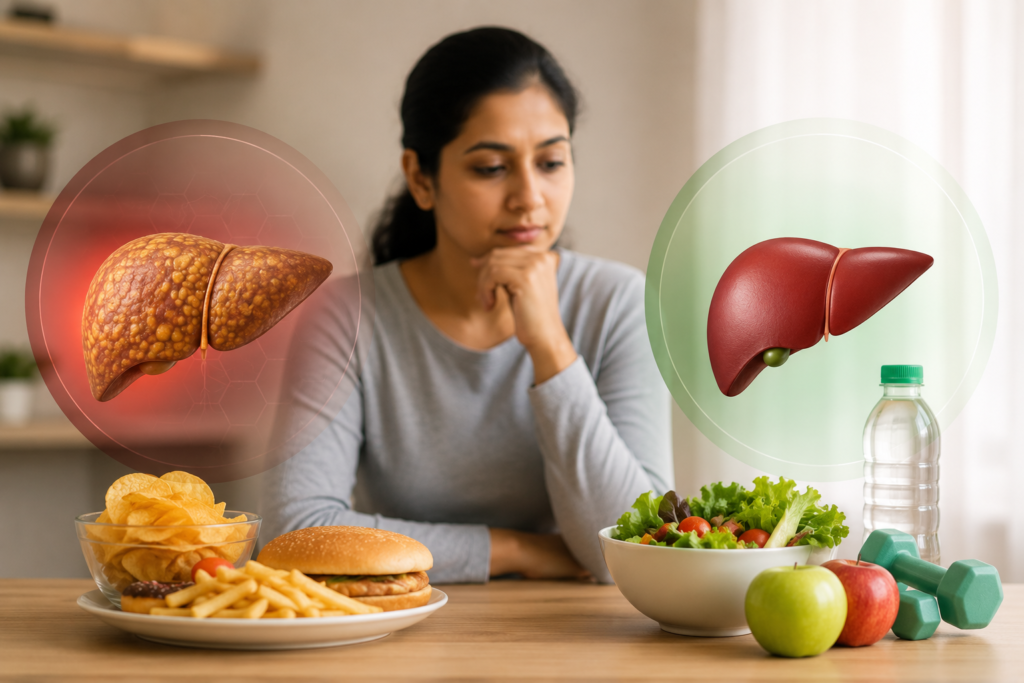
You don’t touch alcohol. You eat a standard, home-cooked diet. You might even go for a daily walk around your neighborhood in Marunji. So, when your doctor looks at your routine ultrasound report and says you have ‘Fatty Liver,’ you are completely blindsided. How did this happen? The truth is, one of the fastest-growing health crises in Pune isn’t caused by binge drinking—it’s hiding in plain sight on your dinner plate, quietly pushing you toward early liver disease without a single warning symptom.
Meet Anjali, a 38-year-old IT professional living near Ashraya Hospital in Pune. She considered herself reasonably healthy. She never drank alcohol and avoided fast food. However, she relied heavily on sweet chai to get through long meetings, frequently ate large portions of white rice for dinner, and snacked on packaged biscuits. When she came in for a routine annual health check-up complaining of mild, unexplained fatigue, her ultrasound revealed Grade 1 Fatty Liver. She was shocked, asking, “But I don’t eat greasy food, so how is my liver fatty?” Anjali’s story is incredibly common, and it highlights a fundamental misunderstanding about how our bodies process everyday foods and lifestyle habits.
What Exactly is Fatty Liver?
In the medical world, Fatty Liver has recently been renamed to MASLD (Metabolic Dysfunction-Associated Steatotic Liver Disease). The term “steatosis” simply means fat accumulation. Your liver functions as the body’s central processing plant, managing everything you eat and drink. When the amount of fat coming in, or being produced, exceeds the liver’s ability to export it, the liver cells start storing those fat droplets inside themselves. You can think of your liver like a warehouse; a few extra boxes of fat are fine, but when the aisles are completely blocked, the warehouse cannot function properly.
watermarked_img_3140349651276367100.png
The Hidden Culprits: Sugar and Insulin Resistance
You might wonder why your liver is storing fat if you don’t eat a high-fat diet. The true culprits are often insulin resistance and excess sugar.
- The Sugar Trap: When you consume excess carbohydrates—especially refined sugars and fructose—your liver undergoes a process called De Novo Lipogenesis, which is essentially fat synthesis. The liver is forced to convert that extra sugar directly into fat.
- Insulin Resistance: If you carry extra weight around your middle, your body’s insulin becomes less effective. This insulin resistance causes free fatty acids to leak out of your body’s fat stores and flood straight into your liver.
Understanding the Ultrasound Grades
When you get an ultrasound, it provides a first look at your liver health and usually grades the fat accumulation on a scale of 1 to 3:
- Grade 1 (Mild): The liver looks slightly brighter than normal on the scan, serving as a “yellow flag”.
- Grade 2 (Moderate): The brightness increases, and the blood vessels inside the liver begin to look blurry.
- Grade 3 (Severe): The liver is so bright with fat that the ultrasound waves cannot even see the structures behind it.
The Danger of Ignoring the Signs
Having fat in your liver is merely a storage issue initially. The real danger begins when that fat starts causing active inflammation, a condition known as MASH (Metabolic Dysfunction-Associated Steatohepatitis). The fat irritates the liver cells, causing them to swell and die. To heal itself, the liver creates scar tissue in a process called fibrosis. After 10 to 20 years of this chronic inflammation, the liver can develop cirrhosis. At the cirrhosis stage, the liver becomes hard and nodular, losing its ability to filter toxins or produce vital proteins.
Reversing the Damage: The “Liver-First” Lifestyle
The incredible news is that the liver is the only organ in the human body capable of fully regenerating itself. If you remove the metabolic stress, your liver can heal. To reverse Stage 1 Fatty Liver, you need a targeted action plan:
- The Weight Loss Goal: Aiming for a 7% to 10% total body weight loss is the “magic number” where doctors consistently see liver fat disappear and early scarring begin to reverse.
- The Sugar Strike: You must cut out high-fructose corn syrup, hidden sugars in processed foods, and sodas.
- Carbohydrate Management: Swap out white rice and white bread for complex grains like millets or quinoa, and keep your portion sizes small. Focus on a Mediterranean approach using olive oil, nuts, and leafy greens.
- The Coffee Benefit: Surprisingly, drinking 2 to 3 cups of plain black coffee a day has been shown in studies to reduce liver inflammation.
- Consistent Exercise: You don’t need to run a marathon; engaging in 150 minutes of brisk walking per week is enough to start melting liver fat. Additionally, resistance training builds muscle, which improves insulin sensitivity and helps the liver burn fat even while you are sleeping.
Your Path to Recovery at Ashraya Hospital
A fatty liver diagnosis is a metabolic “check engine” light. It is a critical warning, but it is one you have the power to fix. At Ashraya Hospital, located conveniently in Marunji, Pune, our expert medical teams are equipped with the latest diagnostic tools to accurately assess your liver health and guide your recovery. Don’t wait for a silent epidemic to become a vocal problem.
Ready to prioritize your health? Explore our resources below:
- Home | Discover our state-of-the-art facilities.
- About Us | Learn more about our commitment to patient care.
- Doctors | Meet our expert specialists.
- Contact Us | Reach out today to schedule your comprehensive liver health check.
- Blog | Read more health tips and insights.
📍 Visit Us: Ashraya Hospital, Marunji, Pune, Maharashtra
Recent Posts
-
 World Heart Day: Know the Warning Signs of Heart Problems Before They Become an Emergency
 -
 Post-Monsoon Respiratory Infections: Why September Can Trigger Cough, Cold and Breathing Problems
 -
 Menopause: Managing Symptoms for Better Quality of Life
 -
 Pregnancy Care: Important Health Checkups in Every Trimester
 -
 Irregular Periods: When Should You Be Concerned?